
Multi-Supplier Consolidation in China: How to Control Quality, Cartons, and Shipping

Multi-supplier consolidation in China combines goods from several factories into one controlled shipment. It can reduce fragmented freight and simplify delivery, but only when every supplier follows the same product-identification, quality, packaging, documentation, and delivery rules. The safest process uses one consolidation plan, an inbound checklist for each supplier, inspection evidence before acceptance, a final carton and packing-list reconciliation, and a written shipment-release decision.
Ordering from several factories creates more than a logistics task. Each supplier may use different carton marks, packing-list formats, quality standards, production schedules, or interpretations of the buyer's instructions. If the goods are simply delivered to one warehouse and loaded together, errors from one supplier can contaminate the whole shipment.
Typical failures include:
The objective is not merely to put several orders into one container or courier booking. It is to create one accountable release process across separate factories.
Start before production finishes. Create a control sheet that identifies each supplier, purchase order, SKU, expected quantity, packaging specification, required labels, inspection status, planned warehouse arrival, and shipping priority.
The sheet should answer five questions for every inbound batch:
Use internal references instead of public customer names or order details in working screenshots and external content. The control system needs traceability without exposing private buyer information.
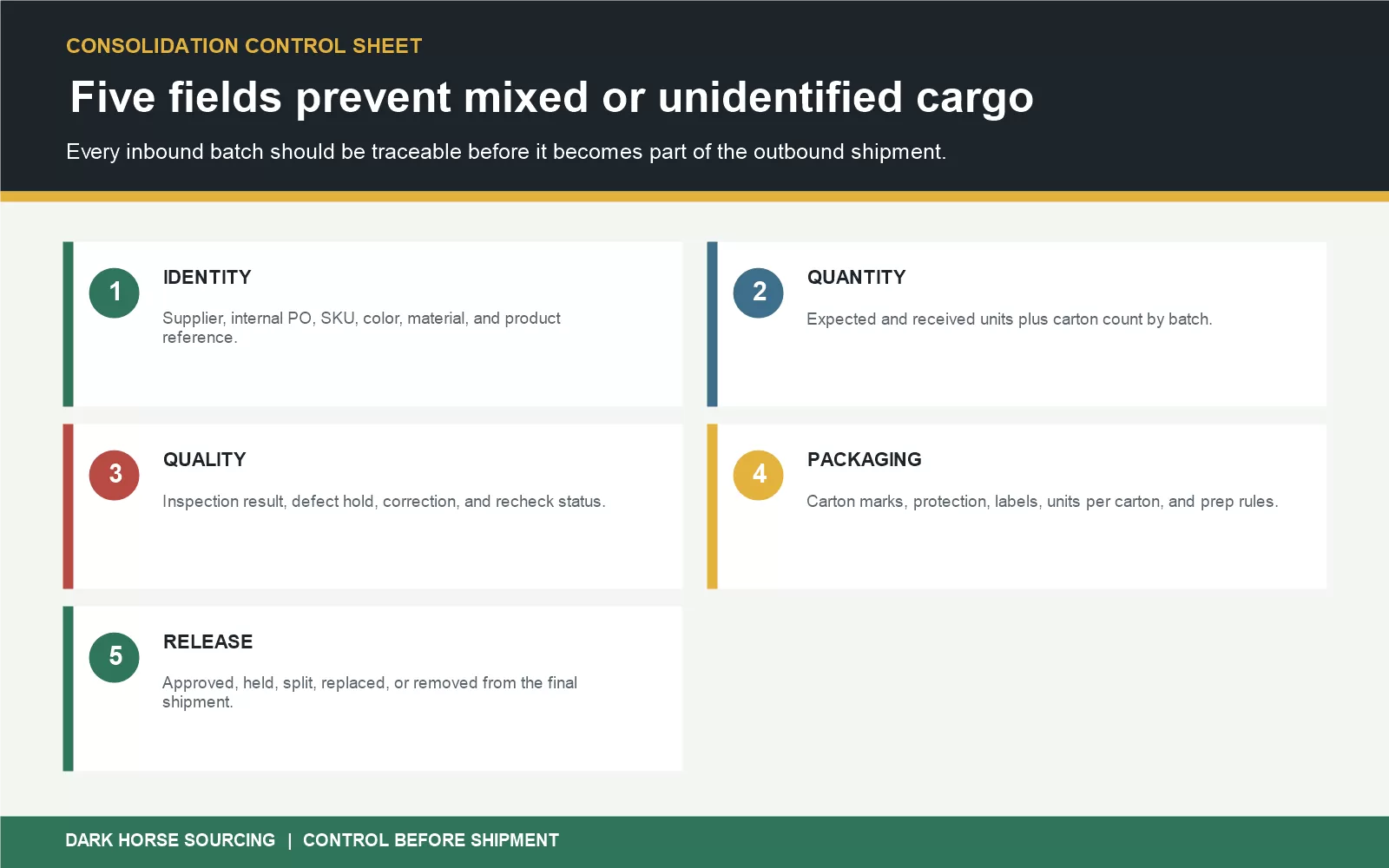
Every supplier should receive the same warehouse-delivery instructions. Require an outer-carton reference that connects the delivery to the control sheet. The warehouse should record the delivery date, carton count, visible carton condition, supplier reference, and any mismatch at receipt.
Do not rely on a factory contact saying that the goods were delivered. Ask for warehouse acceptance evidence. If cartons cannot be linked to a supplier and SKU, isolate them until identity is confirmed.
A practical inbound checklist includes:
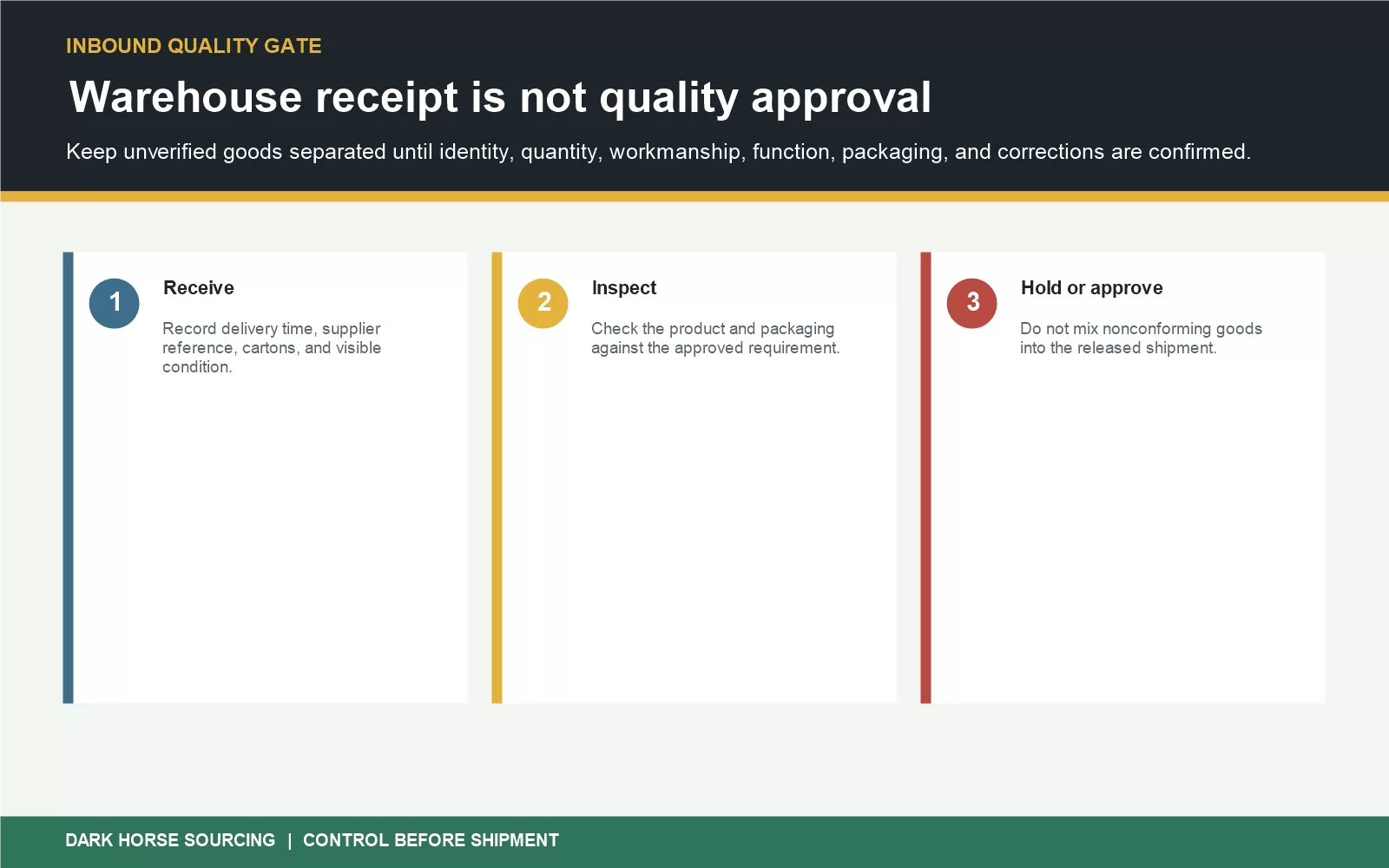
Warehouse receipt does not mean quality approval. A batch can arrive on time and still contain the wrong material, inconsistent finish, missing accessories, incorrect labels, or packaging that does not match the approved sample.
Define the inspection requirement for each supplier according to product risk. This may include product identity checks, quantity verification, workmanship sampling, function tests, measurement checks, packaging review, and photo or video evidence. Nonconforming goods should be placed on hold rather than mixed into the final shipment.
When a supplier corrects a problem, document the corrective action and recheck the affected points. A promise to repair or replace goods is not a release decision.
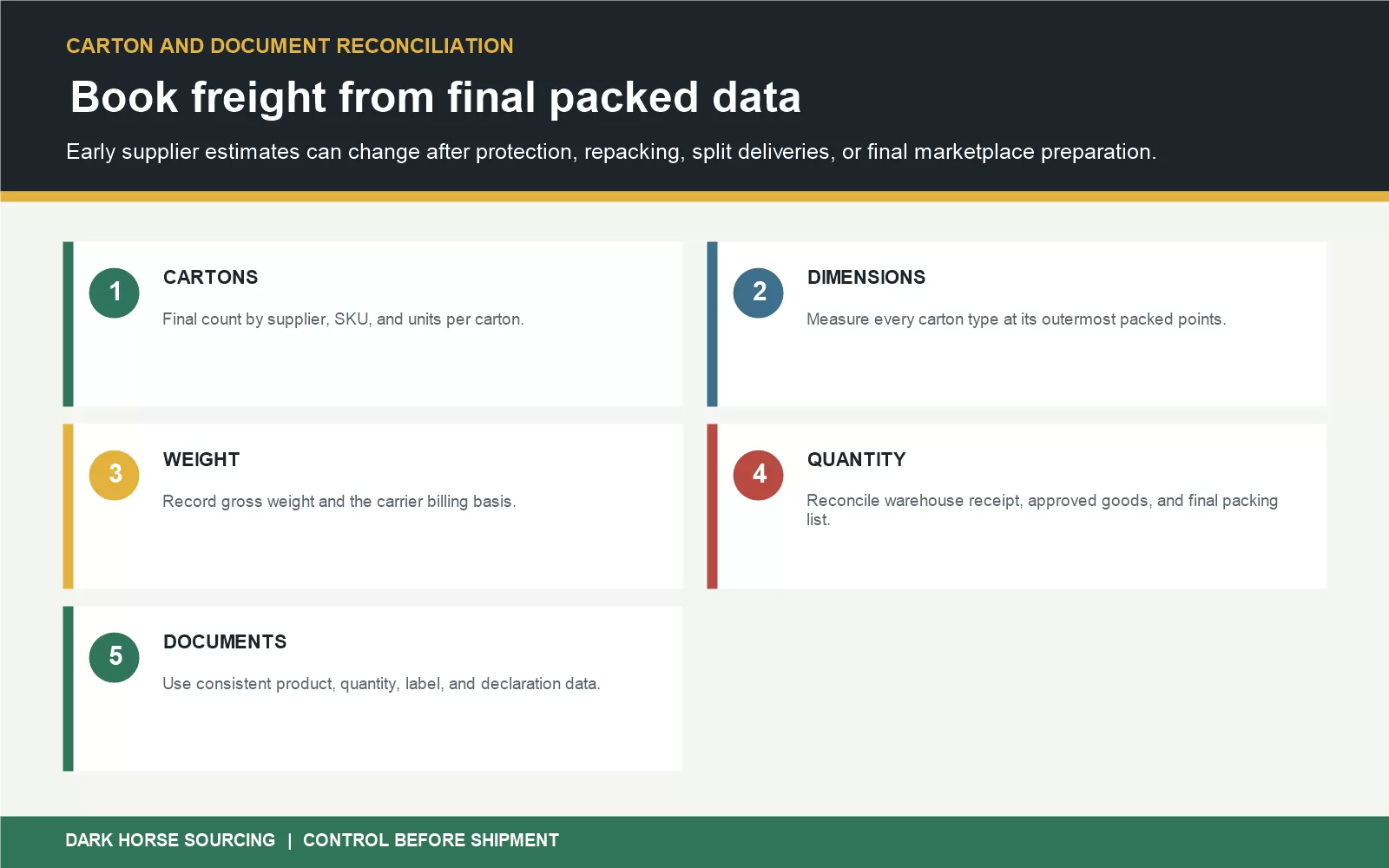
Freight planning should use final packed-carton data, not early supplier estimates. Once all approved batches are at the consolidation warehouse, reconcile:
The warehouse should report changes before booking. A larger carton, extra protective material, split delivery, or missing batch can change chargeable weight, container utilization, delivery timing, and customs paperwork.
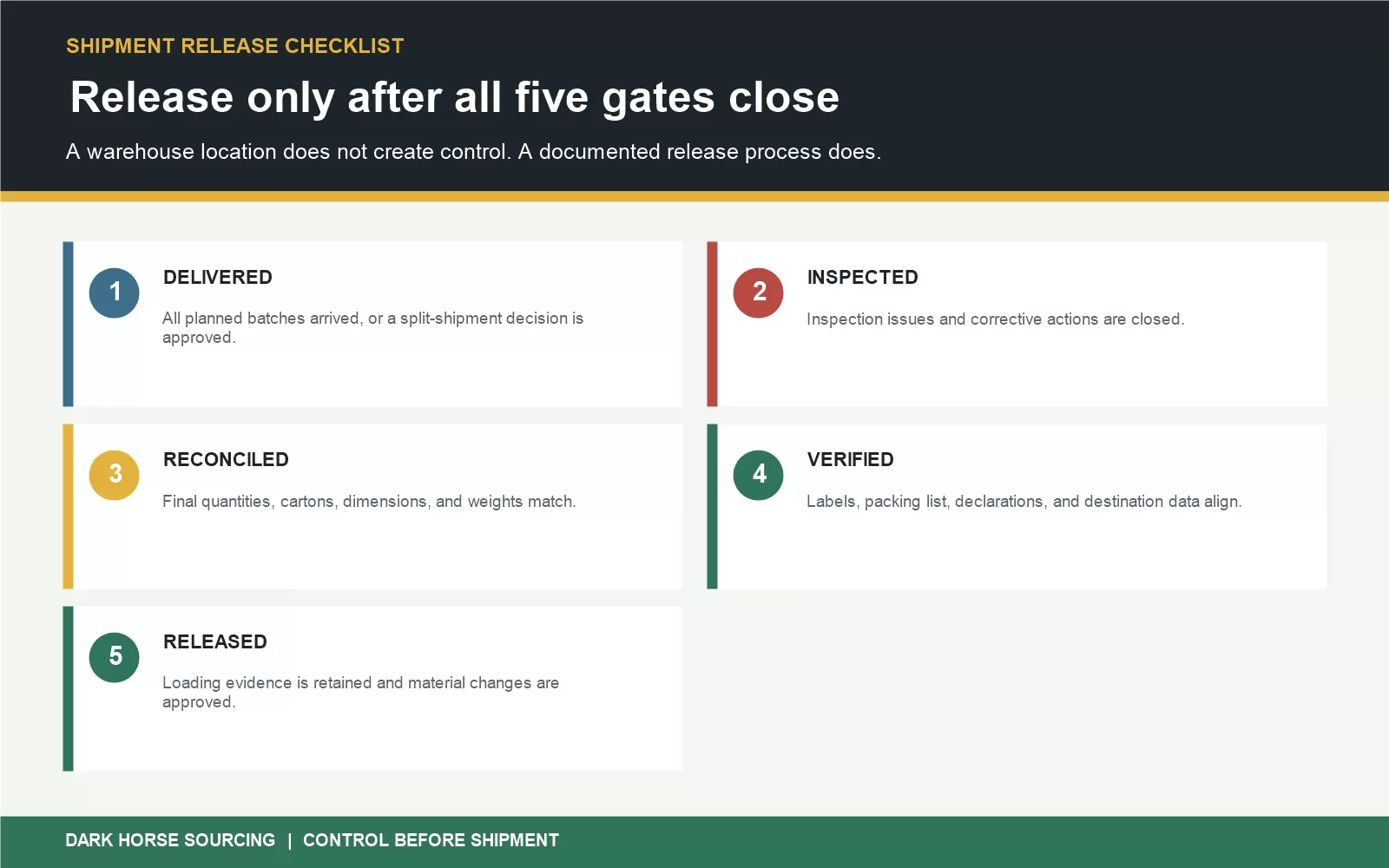
The final release decision should be explicit. Before loading or courier pickup, confirm that every included batch is identified, approved, counted, packed, labeled, and represented correctly in the final documents.
The release checklist should confirm:
Consolidation is not automatically the lowest-risk option. Separate shipments may be better when one supplier is substantially late, products require incompatible handling, customs or compliance documentation differs materially, urgent inventory must move first, or holding finished goods creates unacceptable storage risk.
Compare the total operational effect, not only the headline freight quote. Include warehouse handling, storage, inspection, repacking, labeling, delay exposure, and the cost of correcting mixed or unidentified goods.
Dark Horse Sourcing operates as a China sourcing risk-control partner for overseas buyers. Support can include supplier coordination, requirement confirmation, production follow-up, inbound warehouse control, quality inspection coordination, carton and document reconciliation, and shipment release support. The goal is to turn several separate factory orders into one visible and accountable process.
It is the process of receiving goods from multiple Chinese suppliers at one controlled location, checking and combining them, and arranging one coordinated outbound shipment.
No. It may reduce fragmented freight, but warehouse handling, storage, repacking, inspection, delays, and product-specific requirements can offset the savings. Compare total landed and control costs.
Inspection requirements should be defined before shipment. Some checks can happen at the factory and others at the consolidation warehouse. Warehouse receipt alone should never be treated as quality approval.
Use a shared labeling convention, internal purchase-order and SKU references, an inbound receipt record, separate hold areas for unverified goods, and a final packing-list reconciliation.
The buyer should compare the inventory need, storage cost, freight impact, and new delivery date, then document whether to wait, split the shipment, or remove the late batch from the consolidation plan.
Dark Horse Sourcing can support supplier coordination, production follow-up, quality control, consolidation checks, and shipment coordination based on the buyer's product and delivery requirements.
Managing several Chinese suppliers without one control point can turn small inconsistencies into shipment-level problems. Request a China Sourcing Risk Assessment to review supplier coordination, quality gates, consolidation requirements, and release controls for your next order.
Contact us
Call Us: +86 193 7668 8822
Email:info@darkhorsesourcing.com
Add: Building B, No.2, He Er Er Road, Dawangshan Community, Shajing Street, Bao'an District, Shenzhen, China
 @Darkhorsesroucing


 EN
EN
 ar
ar
 da
da
 nl
nl
 fr
fr
 hu
hu
 it
it
 pl
pl
 pt
pt
 es
es
 sv
sv
 de
de
 cs
cs
 ga
ga
 ro
ro
 sk
sk
 tr
tr
 hi
hi
 ru
ru
 bn
bn