
Replica Products from China: Legal Risks and Safer Sourcing Alternatives

Replica products from China can expose an importer to trademark, copyright, design-right, customs, marketplace, payment, and product-safety risks. The word "replica" does not create a legal exception: if a product uses protected logos, packaging, artwork, or a confusingly similar design, it may still be treated as counterfeit or infringing. The safer sourcing route is to remove protected brand elements, document an original product specification, verify intellectual-property ownership, develop private-label packaging, test samples, and inspect production before shipment.
Replica searches usually begin with a commercial objective: obtain the appearance or perceived status of a popular product at a much lower cost. China has dense manufacturing clusters for bags, footwear, garments, electronics, accessories, and packaging, so buyers may assume that a factory producing similar goods can also reproduce any branded item.
That assumption hides the most important question: does the buyer have the right to make, import, advertise, or sell the product?
A factory's willingness to accept an order is not evidence that the order is legal. A supplier may not know the destination country's rules, may not be the real manufacturer, or may disappear once goods are detained. Importers, marketplace sellers, distributors, and brand owners remain responsible for their own products and claims.
Sellers use many labels, including "1:1 replica," "mirror quality," "designer inspired," "same factory," "OEM version," and "without logo." These are marketing descriptions, not dependable legal classifications.
The actual risk depends on the product and the rights involved:
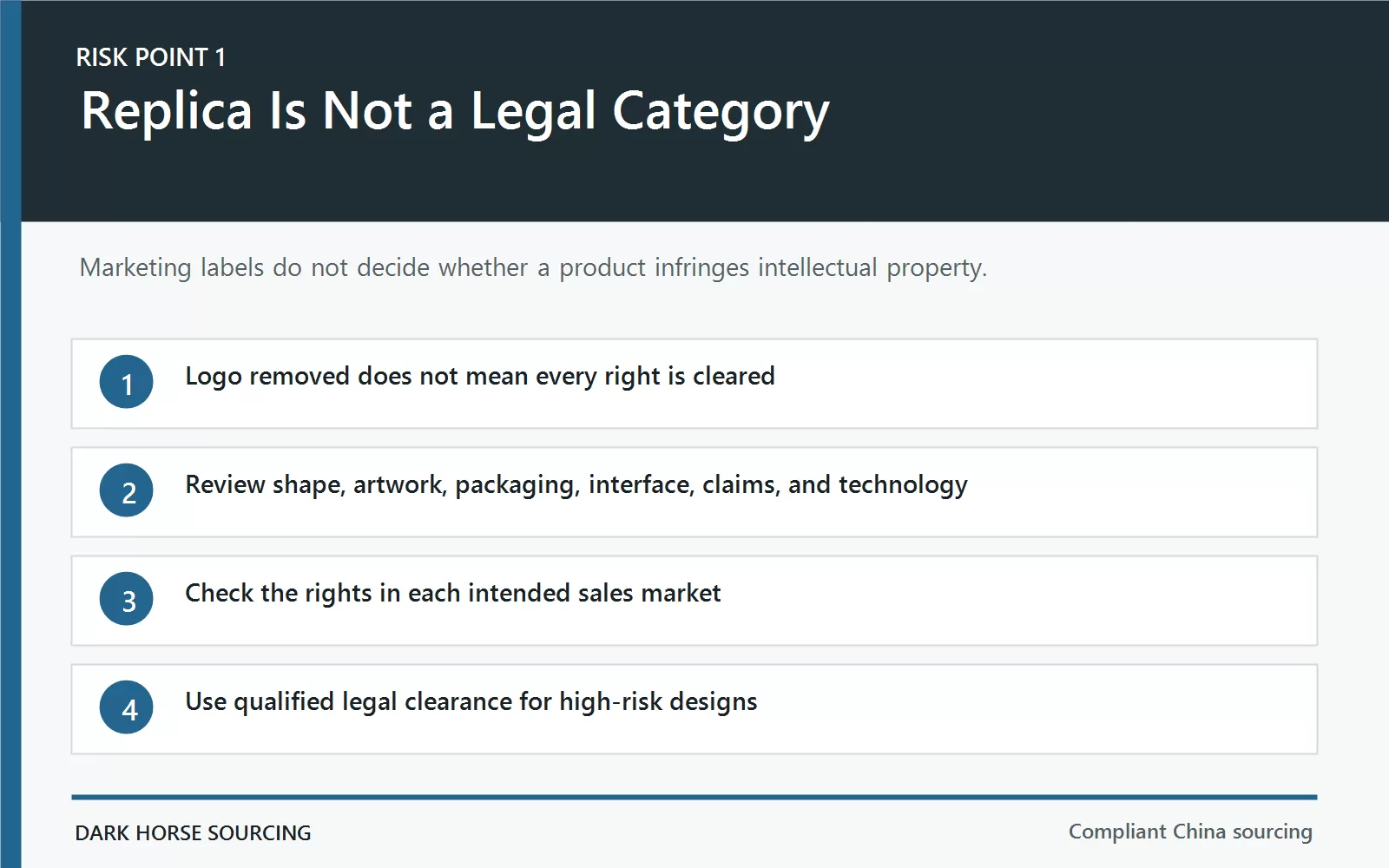
Removing a logo may reduce one obvious issue but does not automatically make the product safe. A distinctive shape, print, interface, package, or patented mechanism can create separate exposure.
Customs authorities in many markets can detain suspected counterfeit or infringing goods. A shipment can be delayed while documents are reviewed or a rights holder is contacted. Possible outcomes may include seizure, destruction, storage charges, penalties, or investigation. The importer may lose both the goods and the freight already paid.
Declaring a vague description or incorrect value does not solve the underlying problem. It adds documentation and customs risk to the intellectual-property risk.
Amazon, eBay, social-commerce platforms, payment processors, advertising networks, and fulfillment partners maintain their own intellectual-property policies. A complaint can lead to listing removal, inventory quarantine, account suspension, reserve holds, or frozen payouts even before a court decides the issue.
Invoices from an unknown trading company rarely prove authorization. Marketplaces may ask for a traceable supply chain, authentic invoices, licensing evidence, brand authorization, or product-compliance documents.
Replica supply chains often compete on visual similarity and speed rather than controlled specifications. A sample may use one material while production uses another. Hardware, coatings, batteries, adhesives, plastics, inks, and packaging can change without notice.
Common quality failures include:
Without an approved bill of materials, test plan, packaging specification, and change-control process, a buyer cannot reliably reproduce the sample.
Suppliers handling questionable orders may avoid formal contracts, request payment to unrelated entities, change beneficiary details, or refuse to identify the factory. Some present stolen factory images or claim access to an "original production line" without evidence.
If the supplier relationship is intentionally opaque, normal remedies become difficult. The buyer may not know which company received payment, made the goods, applied the marks, or arranged export.
Replica sales depend on another company's demand, design work, reputation, and enforcement tolerance. Even if a first order clears customs, the seller has not built defensible intellectual property or a stable product platform. Listings, domains, ads, payment accounts, and inventory can become stranded at any time.
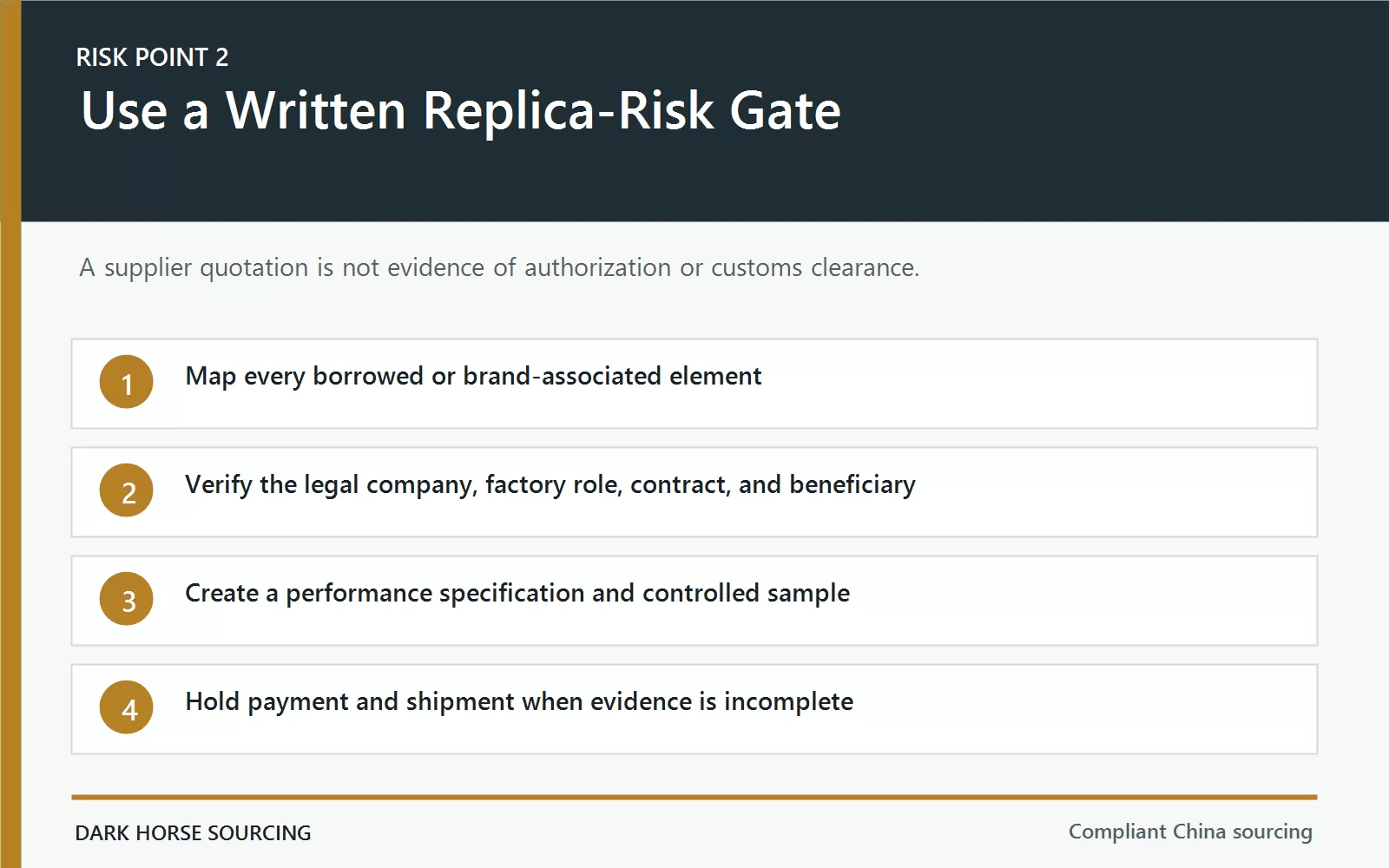
Before paying a supplier, run the proposed product through a written risk gate.
List the product name, logo, monogram, shape, print, artwork, packaging, interface, accessories, manual, photography, and claims. Do not limit the review to the most visible logo.
Ask who created each element and who owns it. If the answer is "everyone sells it" or "the factory has made it for years," ownership is still unproven.
Intellectual-property rights are territorial and product-specific. Have qualified counsel or an appropriate clearance service review the intended sales markets. Search relevant trademark, design, copyright, and patent issues before finalizing tooling or packaging.
This article provides sourcing-risk guidance, not legal advice. A supplier or sourcing agent should not replace legal clearance.
Confirm the registered company, business license, operating address, factory role, contracting entity, invoice entity, and bank beneficiary. Any difference should have a documented explanation.
Require a written agreement covering the buyer's approved specification, intellectual-property representations, subcontracting, change control, confidentiality, inspection, nonconforming goods, and remedies. Contract language does not cure infringement, but it helps expose suppliers that refuse accountability.
Create a performance-based specification. Define materials, dimensions, functions, safety requirements, durability, labeling, packaging, and acceptable tolerances. Test the product against its intended use instead of asking whether it "looks original."
Approve production only after the legal design direction, golden sample, bill of materials, test plan, packaging, and labeling are controlled. Inspect finished goods and close deviations before release.
Stop and review the order when a supplier:
These signals do not describe a controlled OEM relationship. They indicate that the supplier expects the buyer to absorb the legal and commercial risk.
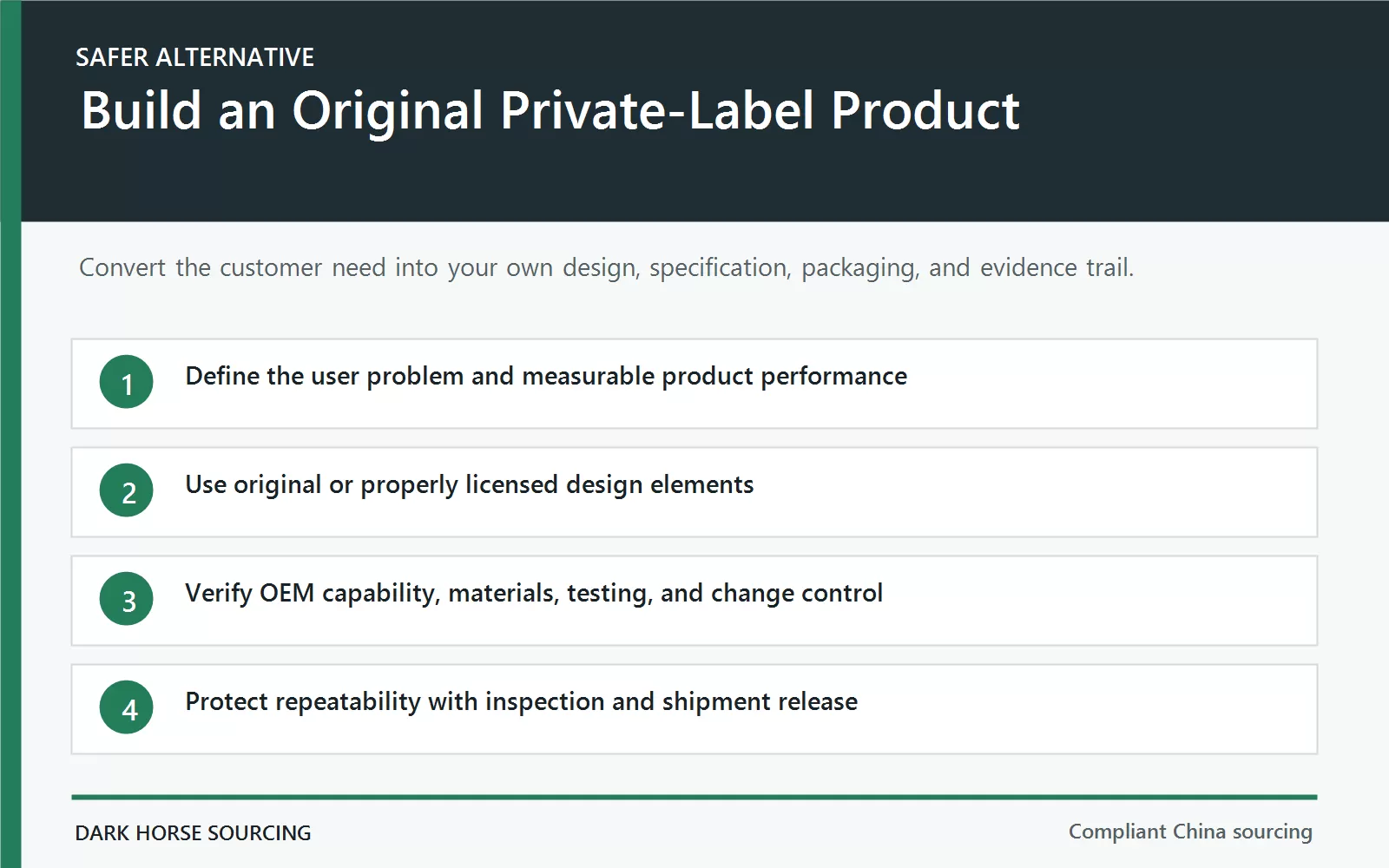
Start with a real customer problem, target price, performance requirement, and original design direction. A private-label product can use proven manufacturing processes without copying protected brand elements.
The development brief should define:
If the business needs recognizable artwork, characters, patterns, or technology, obtain a license or use properly cleared assets. Keep the license scope, territory, product categories, duration, and approval conditions in the project file.
An experienced product team can map the functional need separately from the protected appearance. Change the silhouette, proportion, construction, interface, decoration, package, and naming system while preserving the intended customer benefit.
The goal is not a cosmetic workaround. It is a product with its own design logic and evidence trail.
A compliant supplier should be willing to identify the legal entity, explain whether it is a factory or trading company, discuss tooling and ownership, provide current production evidence, support testing, and accept inspection.
Once the product direction is cleared, use the same controls required for any serious China sourcing project:
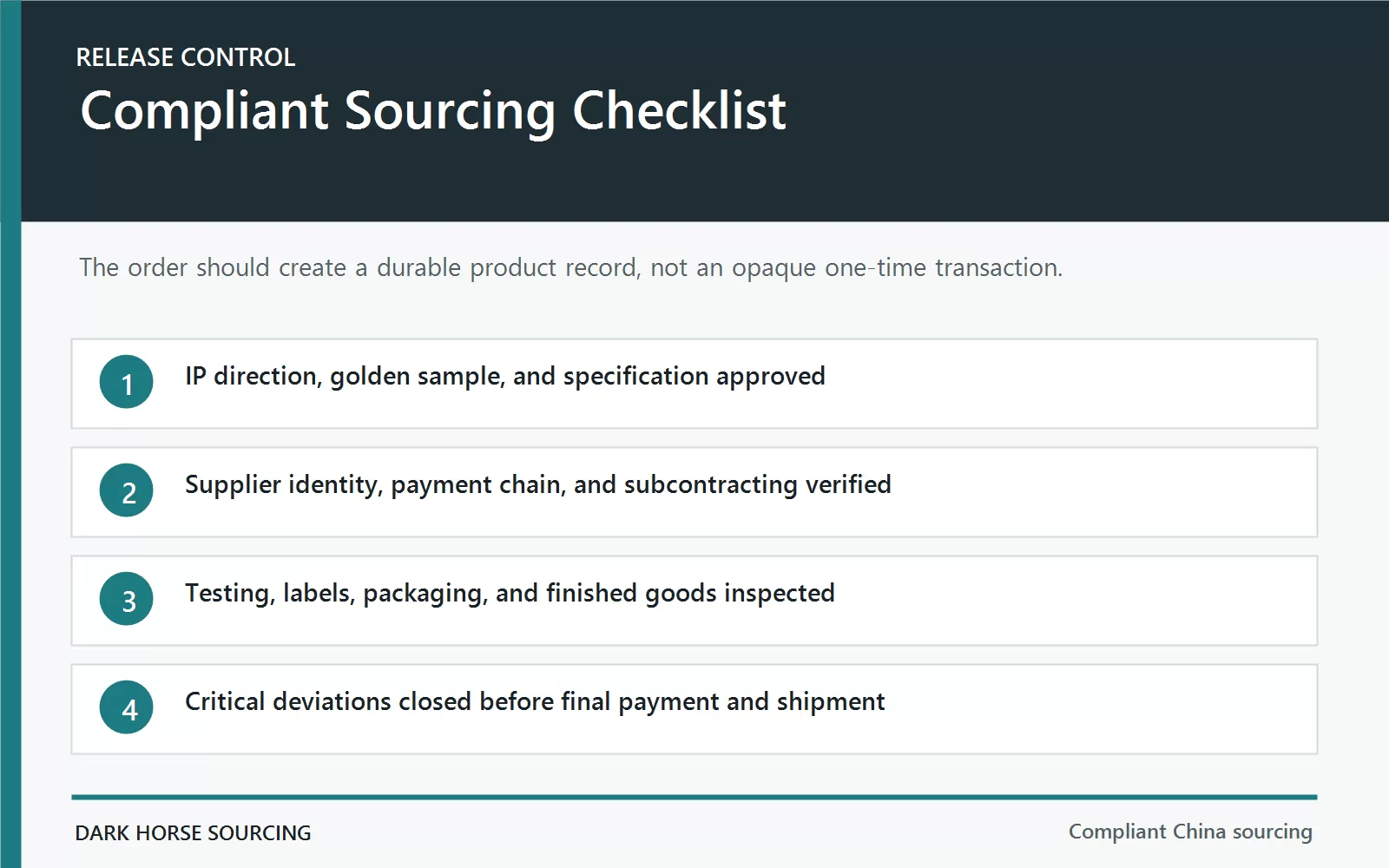
This process produces something replica sourcing cannot: a repeatable product record that supports future orders, quality improvement, marketplace evidence, and brand value.
Dark Horse Sourcing does not source counterfeit or unauthorized branded goods. We help overseas buyers turn product ideas into controlled, compliant sourcing projects through supplier verification, specification development, sampling, quality-control coordination, packaging checks, production follow-up, and shipment-release support.
For buyers who have been offered a "replica," we can help separate the functional product requirement from high-risk brand elements and prepare a safer private-label sourcing brief. Legal clearance should be completed by qualified counsel for the relevant market.
It depends on the product, the rights involved, and the countries where it is made, imported, advertised, and sold. A product may infringe trademarks, designs, copyright, patents, or trade dress even if a supplier calls it a replica or removes the main logo.
Not automatically. Removing a logo may leave risks related to distinctive product shape, packaging, artwork, registered designs, patents, or misleading origin claims.
It is a seller's quality claim suggesting close visual similarity. It is not a recognized guarantee of material quality, authorization, authenticity, legal status, or customs clearance.
A sourcing agent can identify obvious risk signals and document the proposed product and supplier. Formal intellectual-property clearance should come from qualified counsel or an appropriate specialist in the intended market.
Develop an original private-label or OEM product with cleared design elements, a written specification, verified supplier, controlled sample, testing plan, production inspection, and traceable packaging.
No. Dark Horse Sourcing does not source counterfeit or unauthorized branded goods. We support compliant OEM, ODM, and private-label development with supplier and quality controls.
If a supplier has offered you a replica or "same factory" product, request a China Sourcing Risk Assessment before paying a deposit. We can review the supplier identity, product specification, packaging, quality evidence, and safer private-label options.
Contact us
Call Us: +86 193 7668 8822
Email:info@darkhorsesourcing.com
Add: Building B, No.2, He Er Er Road, Dawangshan Community, Shajing Street, Bao'an District, Shenzhen, China
 @Darkhorsesroucing


 EN
EN
 ar
ar
 da
da
 nl
nl
 fr
fr
 hu
hu
 it
it
 pl
pl
 pt
pt
 es
es
 sv
sv
 de
de
 cs
cs
 ga
ga
 ro
ro
 sk
sk
 tr
tr
 hi
hi
 ru
ru
 bn
bn